Mutual Funds Explained: How They Work, Types, Benefits, Risks and Investing Guide
Navigating the world of personal finance can often feel like deciphering a foreign language. With terms like asset…
Read article →

When you start putting your hard-earned money to work, one of the first questions you need to ask yourself isn’t what to invest in, but when you’ll need that money back. This simple concept is known as your investment time horizon. Whether you are saving for a holiday next summer, a house deposit in five years, or a comfortable retirement decades down the line, matching your financial goals to the right time frame is essential. Choosing the wrong strategy can mean taking on unnecessary risk or, conversely, missing out on returns that could outpace inflation.
An investment time horizon is the length of time you expect to keep money invested before you need to use it. It can range from a few months to several decades. Your timeframe matters because different investments behave differently over time. Cash and lower-risk assets can be useful for short-term goals, while shares and other growth-focused investments may have more potential over longer periods. Importantly, a longer time horizon does not remove investment risk. Instead, it gives an investor more time to potentially recover from temporary market falls.
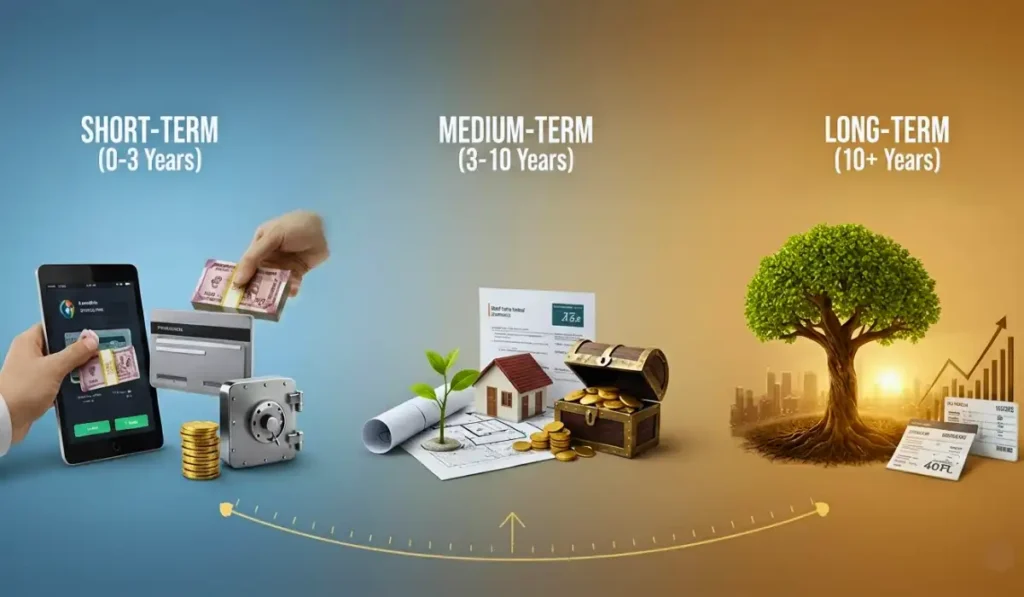
Financial planners generally group time horizons into three distinct buckets: short-term, medium-term, and long-term.
Short-term investing covers goals you want to achieve in the near future. This might include building an emergency fund, saving for a wedding, buying a car, or taking a dream holiday. When your timeline is short, your primary objective should be capital preservation-making sure your original money is safe and accessible when you need it.
Because you need the money soon, you cannot afford to park it in unpredictable markets. If the stock market drops 20% right before you need to pay a house deposit, you won’t have time to wait for a recovery. Short-term investments prioritize high liquidity (how quickly you can convert an asset to cash) and low risk over high returns.
Key takeaway: Keep short-term money out of the stock market. Safety and instant access matter far more than growth.
Medium-term investing sits in the middle ground. Typical goals include saving for a home deposit, funding higher education, or starting a business within the decade.
Here, you have a reasonable window of time, but not an infinite one. You want your money to grow faster than inflation, but you still need to guard against major market downturns near the end of your timeframe.
The goal for medium-term investing is balanced growth. You can afford to take on moderate risk to generate better returns than a standard bank account, but you should balance higher-risk assets with safer options. As you get closer to your target date, a popular tactic is gradually shifting funds from growth assets into conservative ones to lock in your gains.
Long-term investing is where wealth is truly built. Common goals include planning for retirement, building multi-generational wealth, or paying off a 30-year mortgage early. When you have a decade or more ahead of you, short-term market crashes become minor bumps on a long roadmap.
The primary goal here is capital growth. With time on your side, you can embrace market volatility because history shows that broad stock markets consistently trend upward over long periods.
Long-term investors benefit enormously from compound interest-the compounding effect of earning returns on top of your previous returns. Over 20 or 30 years, compounding can turn modest, regular contributions into a substantial nest egg.
Typical Long-Term Assets
| Time Horizon | Typical Timeline | Main Goal | Risk Level | Best Suited Assets |
| Short-Term | 0–3 Years | Capital Preservation | Low | Cash, Savings Accounts, T-Bills, CDs |
| Medium-Term | 3–10 Years | Balanced Growth | Moderate | Bond Funds, Balanced ETFs, Dividend Stocks |
| Long-Term | 10+ Years | Maximum Capital Growth | High | Stock Index Funds, Growth Stocks, Real Estate |
Creating a successful investment strategy isn’t about picking a single timeframe-most people actually manage multiple time horizons at once.
Here is a practical, step-by-step approach to matching your goals with the right investments:
Write down everything you are saving for, along with the estimated cash amount and deadline for each item.
Assign specific account types and asset classes to each goal. Keep your short-term car money in a high-yield savings account, put your house deposit into a balanced ETF, and send your retirement contributions into broad market equity funds.
Your time horizon is dynamic. A 10-year goal will eventually become a 3-year goal. Get into the habit of reviewing your portfolio once a year. As a goal approaches, slowly shift your holdings from growth-oriented assets (like stocks) into stable assets (like cash or short-term bonds) to protect what you’ve built.
Even seasoned investors trip up when managing different timeframes. The most common error is taking too little risk with long-term money; leaving retirement savings in a basic bank account might feel safe, but inflation will erode your purchasing power over several decades. Conversely, taking too much risk with short-term money can be disastrous. Putting a house deposit into volatile individual stocks or crypto to make a quick profit risks losing a chunk of your money right before you need it.
Lastly, avoid panic selling during market drops. If you are investing for a 20-year horizon, a temporary downturn isn’t a crisis-it’s just normal market movement.