Mutual Funds Explained: How They Work, Types, Benefits, Risks and Investing Guide
Navigating the world of personal finance can often feel like deciphering a foreign language. With terms like asset…
Read article →
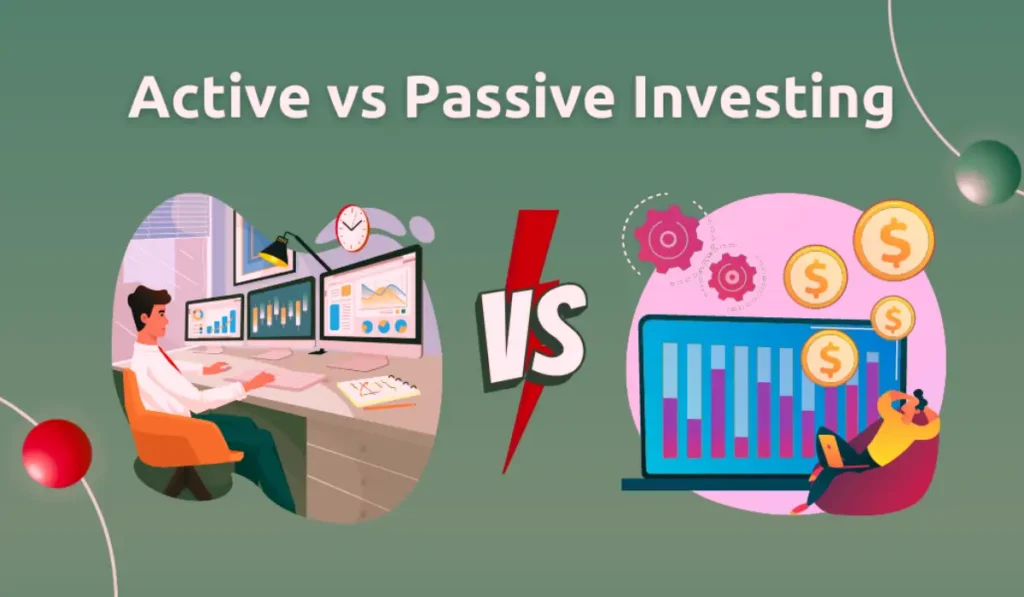
When you start investing, one of the biggest questions is how involved you want to be. Should you research investments and try to beat the market, or take a simpler approach and follow its long-term performance? This is the central question in the active vs passive investing debate. Both strategies can help you build wealth, but they work differently. Active investing involves selecting investments and attempting to outperform a market benchmark. Passive investing aims to match the performance of a particular market or index.
Neither strategy is automatically better. The right choice depends on your financial goals, available time, investment knowledge and attitude to risk.
Active investing is an approach where an investor or fund manager actively selects investments with the aim of achieving better returns than the wider market or a specific benchmark. For example, an actively managed fund may try to outperform an index such as the FTSE All-Share. To achieve this, the fund manager may research companies, examine financial results, follow economic developments and decide when to buy or sell.
Rather than investing in every company within a market, active investors try to identify opportunities they believe could perform particularly well. They may focus on undervalued companies, businesses with strong growth potential, improving profits or industries expected to benefit from changing economic conditions.
Greater responsibility: Investors must continuously evaluate whether their investment decisions are still appropriate as market conditions change.
Difficult to beat the market: Consistently outperforming a broad market index is challenging, even for experienced investors and professional fund managers.
Higher investment costs: Actively managed funds may charge higher fees because of research, management, and trading activity.
Frequent trading expenses: Buying and selling investments regularly can increase transaction costs and other expenses.
Time-consuming: Managing an active portfolio requires ongoing research, monitoring, and decision-making.
Emotional decision-making: Fear, panic, and overconfidence can lead investors to make poor choices during periods of market volatility.
Risk of chasing performance: Investors may buy rapidly rising investments because of recent performance, potentially buying at inflated prices.
Passive investing takes a more hands-off approach. Instead of trying to outperform the market, passive investors aim to match the performance of a particular market or index. This is commonly done through index funds and exchange-traded funds, often known as ETFs. For example, an investor may choose a fund designed to track the FTSE 100, the S&P 500 or a global stock market index.
Rather than selecting individual companies, the investor gains exposure to a wider range of businesses included in the chosen index. The goal is not to beat the market but to participate in its overall long-term performance.
Tracking differences: A passive fund may not perfectly match its index because of fees, expenses, and other factors.
Still involves market risk: If the market or index being tracked declines, the value of the investment can also fall.
No protection from market declines: Passive funds generally continue tracking their chosen index rather than actively moving away from poorly performing areas.
Market-level returns: Investors typically aim to match the performance of the selected index rather than outperform it.
Limited flexibility: Passive investors have less control over which individual companies or sectors are included in the fund.
Requires some research: Investors still need to check the fund’s underlying index, diversification, fees, and investment approach before investing.
Not suitable for every goal: A passive fund may not match every investor’s risk tolerance, time horizon, or financial objectives.
The main differences between active and passive investing involve their goals, costs and level of involvement.
| Feature | Active Investing | Passive Investing |
| Goal | Beat the market | Match the market |
| Management | Actively managed | Follows an index |
| Time required | More research and monitoring | More hands-off |
| Costs | Often higher | Often lower |
| Best for | Hands-on investors | Long-term investors |
Active investing aims to generate returns above a chosen benchmark, while passive investing focuses on following the benchmark’s performance. Active investors may spend more time researching companies and monitoring market developments. Passive investors generally make fewer changes and focus more on long-term market performance.
There is no single winner in the active vs passive investing debate. Active investing may suit people who enjoy researching investments, understand the risks and are willing to spend time managing their portfolios. It can provide greater flexibility and control over investment decisions.
Passive investing may be more suitable for people who prefer simplicity, broad market exposure and a long-term approach. The right choice should depend on your personal circumstances rather than which strategy is currently performing best.
Yes. You do not necessarily have to choose only one approach. Many investors combine active and passive investing within the same portfolio. For example, someone may invest most of their money in broad, low-cost index funds while using a smaller portion for individual shares or actively managed funds. This approach can provide the diversification associated with passive investing while allowing investors to pursue selected opportunities. The important thing is to have a clear reason for each investment decision rather than constantly switching strategies in response to short-term market movements.
Before deciding between active and passive investing, consider a few important factors.
Your investment strategy should support what you are trying to achieve, whether that is building long-term wealth, saving for retirement or reaching another financial goal.
Active investing can require regular research and monitoring. Passive investing may be more suitable if you prefer an approach that requires less ongoing attention.
All investments can rise and fall in value. Consider how comfortable you would be if your portfolio lost value during a market downturn.
Compare management fees, fund charges and trading costs. Even relatively small costs can affect your returns over the long term.
The active vs passive investing debate has no single right answer. Active investing offers greater control and the potential to outperform the market but requires more time and effort. Passive investing is simpler and often lower in cost, but investors must accept market ups and downs. Ultimately, the best strategy is one that matches your financial goals, risk tolerance and investment timeframe.