
Investing: A Complete Guide to Building Wealth, Growing Money and Making Smarter Investment Decisions

Investing is one of the most important tools for building long-term financial security. Rather than simply keeping money aside, investing involves putting capital into assets with the expectation that those assets will generate returns over time. Those returns may come from price growth, interest, dividends, rental income or other forms of income. For many people, investing can seem complicated at first. There are stocks, bonds, mutual funds, exchange-traded funds, property, commodities and other investment choices to consider. Markets can rise and fall, investment values can change quickly, and financial terminology can make the subject appear more difficult than it needs to be.
The good news is that investing does not have to begin with advanced financial knowledge. A strong foundation starts with understanding your goals, learning how different investments work, knowing how much risk you can accept and creating a sensible long-term plan.
This guide explains the fundamentals of investing, from the meaning of investment and the main types of assets to risk, diversification, compound growth, portfolio construction and common mistakes. It also provides a practical introduction to investing for beginners who are ready to understand how their money can work towards future goals.
What Is Investing?
Investing means putting money into an asset or financial product with the expectation that it will potentially increase in value or generate income over time. When you leave money in a traditional savings account, you generally expect interest in return for keeping your money there. With investing, the potential return can come from several sources. A share may increase in price, a bond may pay interest, a company may distribute dividends, or a property may generate rental income.
However, investing is different from simply saving because investment returns are not guaranteed. The value of investments can rise and fall, and you may lose some or all of your original capital. The potential for higher returns generally comes with greater risk.
This is why successful investing is not simply about finding the investment that could make the most money. It is about finding investments that fit your goals, time horizon and ability to handle losses.
Why Do People Invest?
People invest for different reasons, but the underlying objective is usually to make their money work towards a future financial goal.
Some common investing goals include:
- Building long-term wealth
- Preparing for retirement
- Funding education
- Buying a home
- Creating an additional source of income
- Protecting purchasing power against inflation
- Building financial independence
- Leaving money for future generations
The longer your investment horizon, the more opportunity your money may have to benefit from growth and compounding. At the same time, longer periods also mean accepting that markets may experience several periods of volatility along the way. Before choosing an investment, it is therefore useful to define what you are investing for and when you expect to need the money.
Investing vs Saving
Saving and investing are closely related, but they serve different purposes. Saving generally means keeping money somewhere relatively accessible and stable for short-term needs. An emergency fund, upcoming holiday or near-term purchase may be better suited to savings than investments that can fluctuate in value. Investing is generally more appropriate for money that can remain invested for longer periods. Long-term investments may have greater potential for growth, but they can also experience temporary or permanent losses.
A sensible financial plan can therefore include both. Savings can provide stability and liquidity, while investments can provide a pathway towards long-term growth. Investor.gov similarly recommends establishing savings for emergencies and short-term needs while considering investing for longer-term goals.
How Does Investing Work?
At its simplest, investing works through ownership or lending. When you buy shares in a company, you acquire a small ownership interest in that business. If the company becomes more valuable and the share price rises, your investment may increase in value. Some companies may also pay dividends to shareholders. When you buy a bond, you are essentially lending money to an issuer, such as a government or company. In exchange, the issuer may pay interest and return the principal according to the terms of the bond.
With a property investment, returns may potentially come from rental income and changes in the property’s value. Investment funds work differently again. A mutual fund, for example, pools money from many investors and uses that money to purchase a portfolio of securities or other assets. This can allow an individual investor to gain exposure to many holdings through one investment.
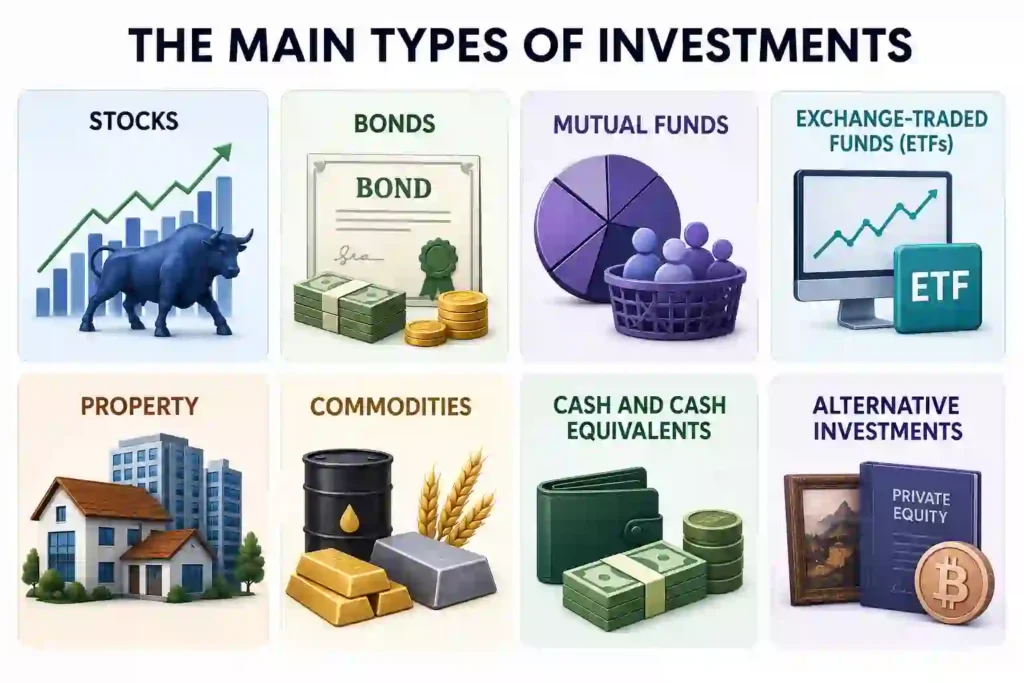
The Main Types of Investments
There is no single investment that is right for everyone. Different assets have different levels of risk, return potential, liquidity and complexity.
Stocks
Stocks represent ownership in companies. When you buy a company’s shares, you become a shareholder and participate in the financial performance of that business. Stocks can provide returns through capital appreciation and, for companies that distribute them, dividends. They can be useful for long-term growth but are also capable of significant price fluctuations. A company’s earnings, competition, economic conditions, interest rates, investor sentiment and many other factors can influence its share price.
Bonds
Bonds are debt investments. Governments, companies and other organisations may issue bonds to raise money. The investor generally receives interest according to the bond’s terms and may receive the principal back at maturity. Bonds are often considered less volatile than shares, although they are not risk-free. Bond investors can face credit risk, interest-rate risk, inflation risk and other risks.
Mutual Funds
A mutual fund pools money from multiple investors and invests it in a collection of assets such as shares, bonds or other securities. For beginners, mutual funds can be appealing because they may provide diversification without requiring an investor to research and purchase every underlying security individually. However, not every mutual fund is broadly diversified. A fund focused on a particular industry, country or theme can still carry considerable concentration risk. Investors should examine the fund’s holdings, strategy, costs and risks before investing.
Exchange-Traded Funds
Exchange-traded funds, commonly known as ETFs, pool investments and generally trade on an exchange like shares. Many ETFs track an index, sector, commodity or other market segment. They can offer diversification and convenient market exposure, although their risk depends on what they hold.
Property
Property can be an investment through residential or commercial real estate. Returns may come from rental income, capital appreciation or both. Property can provide a tangible asset, but it also comes with costs and risks, including maintenance, taxes, vacancies, financing costs and potentially limited liquidity.
Commodities
Commodities include assets such as gold, silver, oil and agricultural products. Commodity prices can be influenced by supply and demand, geopolitical events, weather, currency movements and economic conditions. They can sometimes behave differently from stocks and bonds, which may make them useful as part of a broader portfolio, although they can also be volatile.
Cash and Cash Equivalents
Cash and cash-like investments are generally used for liquidity and short-term needs rather than aggressive long-term growth. They can play an important role in an investment portfolio because not every pound or rupee needs to be exposed to market volatility.
Alternative Investments
Alternative investments can include assets such as private equity, hedge funds, infrastructure, collectibles and certain digital assets. These investments can have different return characteristics from traditional assets, but they may also involve greater complexity, limited liquidity, higher fees or significant risks.
Understanding Investment Risk
Risk is an unavoidable part of investing. There is no investment that can guarantee a high return without risk. In general, investments offering greater potential returns also expose investors to greater potential losses. Some major types of investment risk include:
Market risk: The value of an investment can decline because the wider market falls.
Company risk: An individual business may experience poor management, falling sales, increasing costs or other problems.
Interest-rate risk: Changes in interest rates can affect the value of certain investments, particularly bonds.
Inflation risk: Inflation reduces purchasing power, meaning money may buy less in the future.
Liquidity risk: Some assets may be difficult or expensive to sell quickly.
Credit risk: A borrower or bond issuer may fail to meet its financial obligations.
Concentration risk: Having too much money in one investment, industry or asset class can increase the impact of a negative event.
Understanding risk does not mean avoiding it completely. Instead, investors should understand which risks they are taking and whether those risks are appropriate for their circumstances.
Risk Tolerance and Time Horizon
Two concepts are particularly important when deciding how to invest: risk tolerance and time horizon. Your risk tolerance is your willingness and ability to accept losses or fluctuations in exchange for the possibility of higher returns. Your time horizon is how long you expect to invest before you need the money. Someone investing for a goal that is decades away may have more time to recover from market downturns. Someone who needs the money within a year may have less ability to tolerate a major fall. Asset allocation should therefore reflect both your risk tolerance and investment timeframe.
The Power of Compound Growth
One of the most important concepts in investing is compounding. Compound growth occurs when your investment earns returns and those returns themselves remain invested and potentially generate further returns. Imagine investing $1,000 and earning a return. If you leave the original money and its gains invested, future growth can occur on a larger base. Over many years, this can create a significant difference.
The key ingredients are time, consistency and reinvestment.
This is one reason starting early can be powerful. You do not necessarily need a large amount of money at the beginning to benefit from long-term investing. Regular contributions can give compounding more capital to work with as the years pass.
Of course, compound growth is not guaranteed. Actual investment returns vary, and investments can decline in value.
Diversification: Don’t Put Everything in One Investment
Diversification means spreading your money across different investments rather than relying heavily on one.
For example, an investor who puts all their money into one company is highly dependent on that company’s future. If the business performs badly, the entire portfolio could suffer.
A diversified portfolio might instead include different companies, sectors, geographic markets and asset classes.
Diversification can reduce the impact of a poor-performing investment, although it cannot eliminate investment losses altogether. Diversification can happen at multiple levels. You might diversify between shares and bonds, then diversify within your shares by holding businesses from different industries and countries. A mutual fund or ETF can sometimes make diversification easier because one fund may hold many securities. However, investors should check what the fund actually owns rather than assuming every fund is automatically diversified.
Asset Allocation
Asset allocation refers to how you divide your investment portfolio between different asset classes.
For example, an investor could hold a combination of:
- Shares
- Bonds
- Cash
- Property
- Commodities
- Other assets
There is no universally correct allocation. The appropriate mix depends on factors such as your goals, investment horizon and risk tolerance.
Someone investing for a long-term retirement goal may be comfortable with a higher allocation to growth-oriented assets. Someone approaching a major financial goal may prefer greater stability and liquidity. Asset allocation can also change throughout life as financial circumstances and goals change.
Active vs Passive Investing
Investors often approach markets in two broad ways: active and passive investing.
Active investing involves selecting investments with the aim of outperforming a benchmark or market. An investor or fund manager may analyse companies, economic conditions and market trends to decide what to buy and sell.
Passive investing generally aims to track an index or market rather than consistently trying to outperform it.
Index funds and many ETFs are examples of investments that can follow a passive approach.
Neither approach automatically guarantees better results. Investors should consider costs, risk, strategy, diversification and their own knowledge and preferences.

Investing for Beginners: Where Should You Start?
For people new to investing, the biggest challenge is often knowing where to begin.
The first step is not choosing a stock. It is understanding your overall financial position.
Start by identifying your income, expenses, debts, savings and financial goals. Make sure you have adequate money available for unexpected expenses before committing money to investments that may fluctuate.
High-interest debt can also be important to address before taking on significant investment risk.
Once your financial foundation is stronger, establish clear investing goals. Instead of saying, “I want to make money”, consider a specific objective such as building a retirement fund, saving for a house or creating long-term wealth. Then determine how much you can invest regularly without putting your everyday finances under pressure.
How to Build an Investment Plan
A simple investment plan can help prevent emotional decisions.
1. Define Your Goal
Know what you are investing for.Your goal affects the amount you need to invest, the time horizon and the level of risk that may be appropriate.
2. Determine Your Time Horizon
Decide whether the money is intended for a short-, medium- or long-term goal. The shorter the timeframe, the less room you generally have to recover from a major market decline.
3. Understand Your Risk Tolerance
Ask yourself how you would react if your investments temporarily lost 10%, 20% or more. Your emotional reaction matters because an investment strategy is only useful if you can stick with it through difficult periods.
4. Choose an Appropriate Asset Mix
Consider how much exposure you want to shares, bonds, cash and other assets. Your portfolio should reflect your goals rather than simply following whatever investment happens to be popular.
5. Select Your Investments
Once your overall strategy is clear, research individual investments. Look at factors such as the investment’s purpose, historical behaviour, costs, liquidity, diversification and risks.
6. Invest Consistently
Regular contributions can help turn investing into a habit. Rather than trying to predict the perfect day to invest, many long-term investors contribute a set amount at regular intervals.
7. Review and Rebalance
Your portfolio can change over time as some investments grow faster than others. Rebalancing means bringing your portfolio back towards your intended asset allocation. It can help keep your risk level aligned with your original plan.
How Much Money Do You Need to Start Investing?
There is no universal amount required to begin investing. Some investment platforms and funds allow relatively small contributions, making it possible to start with modest amounts. The more important consideration is whether the amount you invest is sustainable.
For example, investing a manageable amount every month can be more useful as a long-term habit than investing a large amount once and then stopping. The goal should be to create a repeatable system that fits your income and expenses.
Understanding Investment Fees
Fees can have a major impact on long-term investment results.
Possible costs include:
- Trading commissions
- Fund management fees
- Platform fees
- Account fees
- Advisory fees
- Transaction costs
- Performance-related charges in some products
A fee that appears small may become significant when applied to a large portfolio over many years.
Before investing, understand what you are paying and what service you are receiving in return. Investor.gov specifically recommends considering investment costs alongside risk, diversification and liquidity.
Investing and Inflation
Inflation is another reason people consider investing. If prices rise over time, the purchasing power of money held in cash can decline. A sum that buys a certain basket of goods today may buy less in the future. Investments that generate returns above inflation over long periods can potentially help preserve or increase purchasing power. However, beating inflation is not guaranteed. Every investment involves uncertainty, and investors should consider both nominal returns and what those returns mean after inflation.
Long-Term Investing vs Short-Term Trading
Investing and trading are not the same activity. Long-term investing generally focuses on owning assets for years and allowing businesses, economies and investments to develop over time.
Short-term trading focuses more heavily on price movements over shorter periods. Trading can involve higher activity, greater emotional pressure and increased transaction costs. Frequent buying and selling can also make it more difficult to maintain a disciplined long-term strategy. Investor.gov notes that frequent trading can be harmful to long-term investment results.
For many beginners, focusing on a long-term plan can be simpler than trying to predict short-term market movements.
The Importance of Research
Investing should not be based entirely on headlines, social media posts or a friend’s recommendation.
Before investing, consider researching:
- What the investment actually owns
- How it generates returns
- The major risks
- The fees and costs
- Its liquidity
- Its level of diversification
- The organisation behind the investment
- Whether the investment fits your goals
For shares, this may involve studying revenue, earnings, debt, competitive advantages and valuation.
For a mutual fund, you might examine its investment strategy, holdings, fees, performance history and level of concentration. The aim is not to predict the future perfectly. It is to understand what you own and why you own it.
Common Investing Mistakes
Beginners can make avoidable mistakes when they focus on excitement instead of strategy.
Trying to Get Rich Quickly
Investing is generally a long-term process. Promises of guaranteed high returns with little or no risk should be treated as major warning signs.
Following Market Hype
An investment that is popular today may not necessarily be suitable for your goals.
Ignoring Diversification
Putting most of your money into one company, sector or asset can expose you to unnecessary concentration risk.
Investing Without an Emergency Fund
Unexpected expenses can force you to sell investments at an inconvenient time.
Taking Too Much Risk
An investment that looks attractive because of its potential return may be inappropriate if you cannot tolerate the downside.
Constantly Checking Your Portfolio
Markets naturally move up and down. Checking your investments every few minutes can encourage emotional decisions.
Ignoring Fees
Small recurring costs can accumulate over long periods.
Buying Something You Do Not Understand
If you cannot explain how an investment works, take time to learn before committing money.
How to Think About Market Volatility
Market volatility is a normal part of investing. Prices can fall because of recessions, political developments, interest-rate changes, company results, geopolitical events, investor sentiment or unexpected news. A market decline does not automatically mean that your long-term investment strategy has failed.
This does not mean investors should ignore losses. Instead, it means you should distinguish between temporary market volatility and a genuine change in the underlying investment. A diversified portfolio and an appropriate time horizon can help investors remain focused on their long-term objectives. Diversification, however, cannot guarantee that a portfolio will avoid losses during a market decline.
Rebalancing Your Portfolio
Suppose you originally decide that your portfolio should contain 70% growth assets and 30% defensive assets.
If the growth portion performs strongly, it could eventually become 80% of your portfolio. Your portfolio would then carry more risk than originally intended. Rebalancing involves adjusting the portfolio to bring it closer to the intended allocation. Some investors rebalance periodically, while others rebalance when allocations move beyond predetermined ranges. The important point is to make the decision according to a plan rather than reacting emotionally to market headlines.
Investing for Different Life Stages
Your investment strategy may evolve as your life changes.
Early Career
At this stage, you may have a long investment horizon and the ability to focus heavily on long-term growth. Building good financial habits can be particularly valuable.
Mid-Career
Income may increase, but so can responsibilities such as housing, children and education. This can be a useful period for increasing contributions and reviewing asset allocation.
Approaching Retirement
As the time when you need your money gets closer, protecting capital and maintaining liquidity may become increasingly important.
Retirement
The focus may shift from accumulating wealth to managing withdrawals, income, taxes, inflation and the longevity of your assets. There is no single portfolio that works for every person at every age. Goals and circumstances should guide the decisions.
Investing for Income
Investments can generate income in several ways. Shares may provide dividends. Bonds can provide interest. Property can generate rent. Some funds distribute income generated by their underlying holdings. Income investing can be useful for people who want cash flow from their portfolios, but investors should not judge an investment solely by its yield. A high yield can sometimes indicate higher risk, falling asset prices or an unsustainable distribution.
The source and sustainability of the income matter.
Tax Considerations
Investment returns can have tax consequences. Depending on where you live and what you invest in, you may face taxes on dividends, interest, capital gains, rental income or other investment income.
Tax rules vary significantly between countries and can change over time. For that reason, investors should understand the tax treatment of their accounts and investments and consider professional tax advice where appropriate.
Protecting Yourself from Investment Scams
Investment fraud can affect both beginners and experienced investors. Be cautious when someone promises guaranteed high returns, claims there is no risk, pressures you to invest immediately or uses social media and private groups to promote an opportunity. Be especially careful if someone asks you to pay additional money before withdrawing supposed profits.
A legitimate investment opportunity should not require you to abandon basic due diligence simply because someone says it is a limited-time opportunity. Investor.gov identifies guaranteed high returns with little or no risk and unregistered professionals among important warning signs.
A Simple Investing Framework
A useful way to think about investing is:
Goal → Time Horizon → Risk → Asset Allocation → Investment Selection → Regular Contributions → Review
Start with the goal, not the product.
For example, instead of beginning with “Which stock should I buy?”, start with “What am I trying to achieve with this money?”
Then consider how long you have, how much risk you can accept and what asset allocation makes sense. Only after those questions should you decide whether individual shares, bonds, a mutual fund, an ETF, property or another investment fits your strategy. This approach can help prevent the common mistake of choosing an investment first and trying to build a financial plan around it afterwards.
Final Thoughts on Investing
Investing is ultimately about putting money to work for future goals while accepting a reasonable level of uncertainty. There is no perfect investment, guaranteed return or universal portfolio. The right approach depends on your financial position, objectives, timeframe and risk tolerance.
For beginners, the most important lessons are relatively simple: understand the difference between saving and investing, build a financial foundation, define clear goals, diversify appropriately, understand fees, invest consistently and avoid decisions driven by fear or excitement.
Over time, investing can become less about finding the next big opportunity and more about following a disciplined process. Compound growth rewards time, while diversification can help manage risk. A thoughtful asset allocation can connect your investments to your goals, and regular contributions can turn investing into a lasting financial habit. Most importantly, investing is a process of learning. You do not need to understand every financial product before you begin learning about markets. Start with the fundamentals, understand what you own, make decisions that fit your circumstances and continue improving your financial knowledge as your experience grows.