The Ultimate Property Investing Guide: How to Invest in Property and Build Long-Term Wealth
Building lasting wealth through real estate is a time-tested strategy that has created more millionaires than almost any…
Read article →

When constructing a resilient long term financial strategy, most investors instinctively look to the stock market as their primary engine for wealth creation. However, true long term financial security and sustainable portfolio growth rely just as heavily on stability, capital preservation, and steady income generation. That is precisely where time tested bond investing strategies play an essential, foundational role.
Whether you are preparing for a comfortable retirement, protecting your hard earned capital against stock market volatility, or seeking a predictable source of regular cash flow, knowing how to choose the right bonds can transform your overall financial health. Understanding how to allocate your capital effectively across fixed income assets empowers you to construct a balanced, weather resistant portfolio tailored precisely to your unique risk tolerance, income requirements, and long term targets.
A bond is a formal contract representing a loan made by an investor to a borrower, typically a sovereign government or a corporation. When you purchase a bond, you act as the lender. In return, the issuer pays you interest at regular intervals, known as the coupon. Once the bond reaches its maturity date, the issuer repays the original loan amount, known as the principal or face value.
Bond prices and market interest rates move in opposite directions. When central banks raise benchmark interest rates, newly issued bonds offer higher coupon yields. Consequently, older bonds paying lower rates drop in market price. Conversely, when baseline rates fall, existing higher yielding bonds become more valuable, driving their secondary market prices up.
[ Central Bank Interest Rates Rise
↓
[ Existing Bond Market Prices Fall ]
↓
[ New Bonds Enter Market with Higher Coupons ]
Bonds do not exist in isolation; they work alongside equities, cash reserves, and term deposits to balance risk and return across your broader portfolio. Every asset class plays a distinct role in your wealth management journey, and understanding how they interact is essential for constructing a weather resistant portfolio.
The ongoing debate between bonds vs stocks boils down to balancing growth against capital security. Stocks represent equity or fractional ownership in a enterprise. When you buy shares, your investment returns depend on company profit growth, market sentiment, and economic conditions. Equities offer strong long term capital appreciation potential, making them the primary engine for wealth creation. However, stocks come with significant price volatility, market downturns, and zero guaranteed payouts. If a company runs into severe financial trouble, equity holders sit last in line during liquidation.
Bonds represent debt obligations rather than ownership stakes. You do not hold equity in the business, but you possess a legally binding claim to receive regular interest payments and full principal repayment ahead of equity holders. This contractual priority makes bonds far less volatile than stocks. While fixed income securities rarely offer the eye popping upside potential of high growth equities, they provide vital income stability, smooth out portfolio returns, and cushion your capital when stock markets take a downturn.
Many conservative investors frequently evaluate the key differences between bonds vs term deposits when seeking low risk income options.
A term deposit is a banking product where you lock a specific sum of money away for a fixed period at a set interest rate. Term deposits are exceptionally safe, typically protected by regulatory backing such as the Financial Services Compensation Scheme (FSCS) up to designated limits. However, they lack structural flexibility. If market interest rates rise significantly after you open a term deposit, your cash remains locked at the lower rate unless you pay a steep early penalty fee.
Bonds offer far greater liquidity, structural choices, and growth potential. Unlike term deposits, standard bonds trade actively on open secondary markets. If you need immediate liquidity or wish to reallocate your capital, you can buy or sell bonds prior to their maturity date. Furthermore, bond markets feature a much wider spectrum of yields, credit profiles, and maturities, enabling you to capture higher long term returns than traditional bank deposit accounts offer during changing economic cycles.
Not all debt instruments carry the same risk profile, structural complexity, or yield potential. The primary distinction every investor must master is government bonds vs corporate bonds.
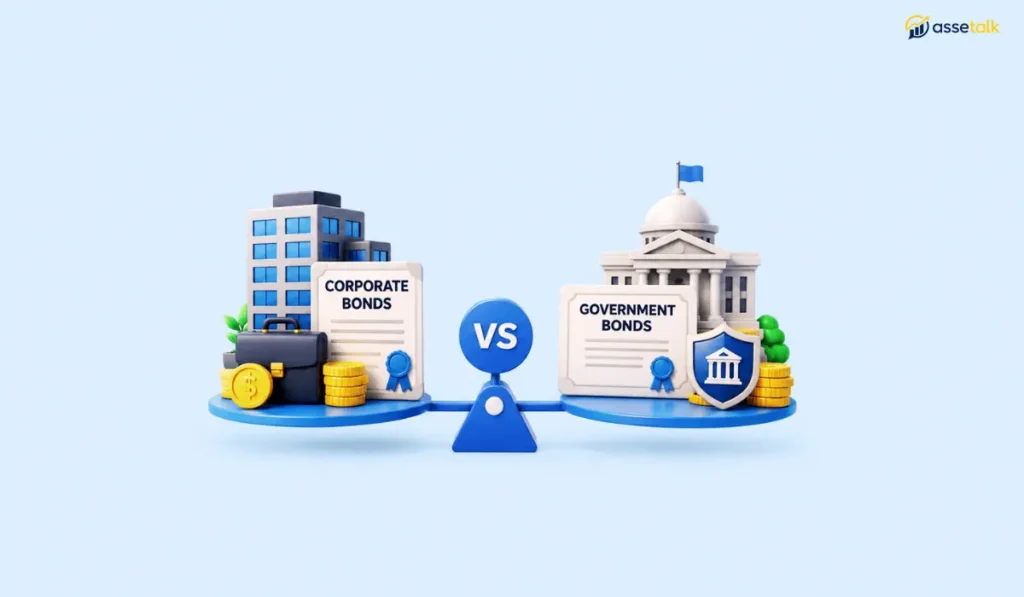
Government bonds are issued by national sovereign authorities to fund public projects, national infrastructure, and ongoing state expenditure. In the United Kingdom, these sovereign debt instruments are famously known as Gilts, while in the United States, they are called Treasury bonds, and in Germany, they are known as Bunds.
Because sovereign governments hold the power to raise public taxes or manage national monetary policy, government bonds issued by developed nations carry minimal default risk. They are widely regarded as the gold standard for capital preservation and act as the ultimate safe haven asset during global recessions or periods of geopolitical instability. The trade off for this supreme level of safety is a lower nominal yield compared to corporate issues.
Government debt generally falls into three main structural subcategories based on maturity:
Corporate bonds are debt securities issued by private and publicly listed corporations looking to raise capital for business expansion, equipment purchases, research, or restructuring existing debt obligations.
Unlike sovereign nations, private corporations cannot print money or levy taxes to cover operational shortfalls. Companies can experience earnings slumps, market share loss, or insolvency. To compensate investors for taking on default risk, corporate debt pays higher interest rates than government bonds of equivalent maturity.
Credit rating agencies audit corporate issuers and divide them into two major market sectors based on creditworthiness:
| Feature | Government Bonds | Investment Grade Corporate Bonds | High Yield Corporate Bonds |
| Issuer | Sovereign Governments | Financially Stable Companies | Leveraged or Growing Firms |
| Default Risk | Negligible / Very Low | Low to Moderate | High |
| Yield Potential | Low to Moderate | Moderate | High |
| Primary Goal | Capital Preservation | Income Generation | High Yield & Growth |
To navigate fixed income markets effectively, keep these essential metrics in mind:
Structured bond investing strategies help you maximize returns while managing interest rate risk effectively.
This approach involves purchasing individual bonds and holding them until their scheduled maturity date. Holding to maturity locks in a set yield and insulates your capital completely from interim price fluctuations in the open market.
The bond laddering strategy spreads your capital equally across multiple securities with staggered maturity dates (e.g., 1, 2, 3, 4, and 5 years). As the short term bond matures each year, you reinvest that principal into a new 5 year bond at current market rates. This strategy provides annual liquidity while smoothing out interest rate cycles.
Initial Setup:
Year 1 Bond: [Matures Year 1] ➔ Reinvest into new 5-Year Bond
Year 2 Bond: [Matures Year 2]
Year 3 Bond: [Matures Year 3]
Year 4 Bond: [Matures Year 4]
Year 5 Bond: [Matures Year 5]
Under this model, you allocate 70 to 80 percent of your fixed income portfolio into a secure core of high grade government debt. You place the remaining 20 to 30 percent into selective satellite holdings, such as high yield corporate debt, to boost overall return.
Matching your asset selection directly to your timeline and risk tolerance is essential:
Direct individual bond purchases give you control over fixed maturity dates and guaranteed face value return at maturity. Bond ETFs pool hundreds of securities, offering instant diversification and daily liquidity, though their market value fluctuates continuously without a single fixed maturity date.
Bond investing strategies are powerful tools that deliver balance, steady cash flow, and downside protection for every type of investor.By understanding how bonds work, weighing government bonds vs corporate bonds, and building a laddered portfolio tailored to your timeline, you can construct a resilient strategy that stands strong through every market cycle. Assess your financial goals today, choose the right fixed income mix, and give your investments the solid foundation they deserve.