The Ultimate Property Investing Guide: How to Invest in Property and Build Long-Term Wealth
Building lasting wealth through real estate is a time-tested strategy that has created more millionaires than almost any…
Read article →
Deciding where to invest your hard-earned money can feel like standing at a financial crossroads. On one side, you have individual stocks, which offer the exciting prospect of owning a slice of a high-flying company. On the other side, you have Exchange-Traded Funds (ETFs), which let you buy a whole collection of investments in a single transaction. The debate between ETFs vs stocks is one of the most fundamental topics in modern investing. Both instruments trade on major stock exchanges throughout the trading day, yet they serve very different roles in a portfolio. Whether you are looking to build long-term wealth or seeking high-growth opportunities, understanding the key differences, risk levels, and return profiles of each will help you make a confident decision. Let’s break down everything you need to know to decide which option best aligns with your financial goals.
An individual stock represents fractional ownership in a single, publicly listed company. When you buy a share of Microsoft, Shell, or Apple, you become a shareholder-meaning you own a tiny portion of that company’s assets and future profits. If the company grows, innovates, and expands its earnings, the value of your shares generally goes up. Many established companies also share their success by paying out cash dividends directly to shareholders.
However, owning individual stocks means your financial fortunes are tied entirely to one business. If the company suffers from poor management, falling profits, or industry disruptions, its share price can plummet quickly, taking your investment down with it.
An Exchange-Traded Fund (ETF) is a pooled investment fund that holds a diverse collection of underlying assets-such as stocks, bonds, or commodities. Instead of buying shares in one company, an ETF allows you to purchase a pre-packaged bundle of hundreds or even thousands of companies at once. Most popular ETFs are index funds designed to track a specific benchmark. For example, an S&P 500 ETF holds shares in 500 of the largest publicly traded companies in the United States. Because ETFs trade on public stock exchanges just like standard stocks, you can buy and sell ETF shares at any point during market hours. The defining feature of an ETF is instant diversification. By spreading your funds across multiple companies, you significantly reduce the impact that any single failing company can have on your total ETFs investment.
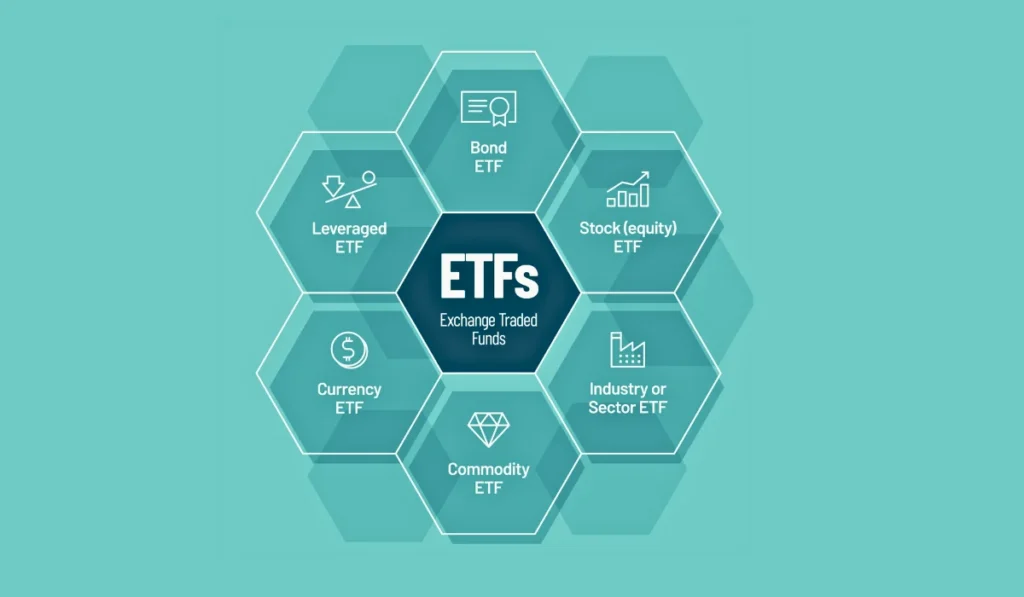
While both instruments are easily accessible through online brokerage accounts, their internal mechanics, risk levels, and management styles differ substantially.
| Feature | Individual Stocks | Exchange-Traded Funds (ETFs) |
| Diversification | Low (Concentrated in a single company) | High (Holds dozens or thousands of assets) |
| Risk Profile | Higher volatility and single-stock risk | Lower, smoothed market risk |
| Potential Returns | Unlimited upside for single company winners | Aligned with average market index growth |
| Management Fees | No ongoing expense ratios | Small annual fee (Expense Ratio) |
| Investor Control | Total control over stock selections | No control over underlying fund holdings |
| Research Effort | High (Requires analysing financial reports) | Low (Set-and-forget passive investing) |
Diversification is often called the only free lunch in finance. When you purchase individual stocks, building a well-diversified portfolio requires purchasing shares in 20 to 30 distinct businesses across various market sectors. With an ETF, a single purchase of $100 gives you immediate exposure to dozens of industries.
If you enjoy analyzing financial statements, listening to quarterly earnings calls, and tracking market trends, individual stocks give you complete control. You decide exactly when to enter or exit a position. With an ETF, a professional fund manager or automated index algorithm determines which assets are included in the fund.
When buying individual stocks, you typically pay only initial brokerage transaction commissions (if any). ETFs, however, charge an annual fee known as an expense ratio. Expressed as a percentage of your holdings (e.g., 0.03% to 0.50%), this small fee covers administrative and operational costs.
When comparing financial risk, individual stocks carry significantly more volatility than broad-market ETFs.
When you put a large portion of your money into a single stock, you expose yourself to “unsystematic risk”-the danger that company-specific events will wipe out your capital. A sudden product recall, regulatory fine, or bad quarterly report can cause a stock price to plunge 20% or 30% in a single day.
ETFs suffer from market-wide swings (known as systematic risk), but they neutralize company-specific failure. If one major company in a 500-stock ETF goes bankrupt, its impact on the total fund value is minimal because hundreds of other thriving businesses offset the loss. Consequently, ETFs deliver far smoother performance over long periods.
The choice between stocks and ETFs often boils down to a classic financial trade-off: stability versus explosive potential.
Individual stocks offer unmatched return potential. If you had invested $1,000 in early-stage tech giants like Nvidia or Amazon 15 years ago, that single position would be worth hundreds of thousands of dollars today. Broad index funds can rarely match the life-changing gains of picking a generational market winner.
While picking winning stocks sounds appealing, history shows that consistently beating the broader market is exceptionally difficult. Over a 10-year period, the vast majority of professional fund managers fail to outperform standard index benchmarks like the S&P 500. For everyday retail investors, attempting to pick individual winners often leads to underperformance due to poor timing and emotional trading. ETFs aim for consistent average market returns. Historically, broad-market equity indexes have generated average returns of around 8% to 10% annually over long horizons. Through the power of compound interest, steady returns from an ETF can turn modest monthly contributions into substantial wealth over time.
Neither investment type is universally superior; the better choice depends entirely on your experience, time commitment, and risk tolerance. ETFs are ideal for beginners who prefer a hands-off, low-maintenance strategy. They suit investors who want long-term wealth growth without the stress of tracking daily financial news or analyzing corporate balance sheets.
Individual stocks are better suited for active, research-oriented investors who want direct control over their holdings. If you have a deep understanding of specific industries and are comfortable with higher volatility in exchange for potential market-beating returns, individual stock picking may appeal to you.
You do not have to choose exclusively between the two. Many seasoned investors use a Core and Explore strategy by placing 70% to 80% of their capital into broad, low-cost ETFs to build a stable foundation. They then allocate the remaining 20% to 30% toward individual high-growth stocks they feel passionate about. This hybrid model gives you strong base