The Ultimate Property Investing Guide: How to Invest in Property and Build Long-Term Wealth
Building lasting wealth through real estate is a time-tested strategy that has created more millionaires than almost any…
Read article →
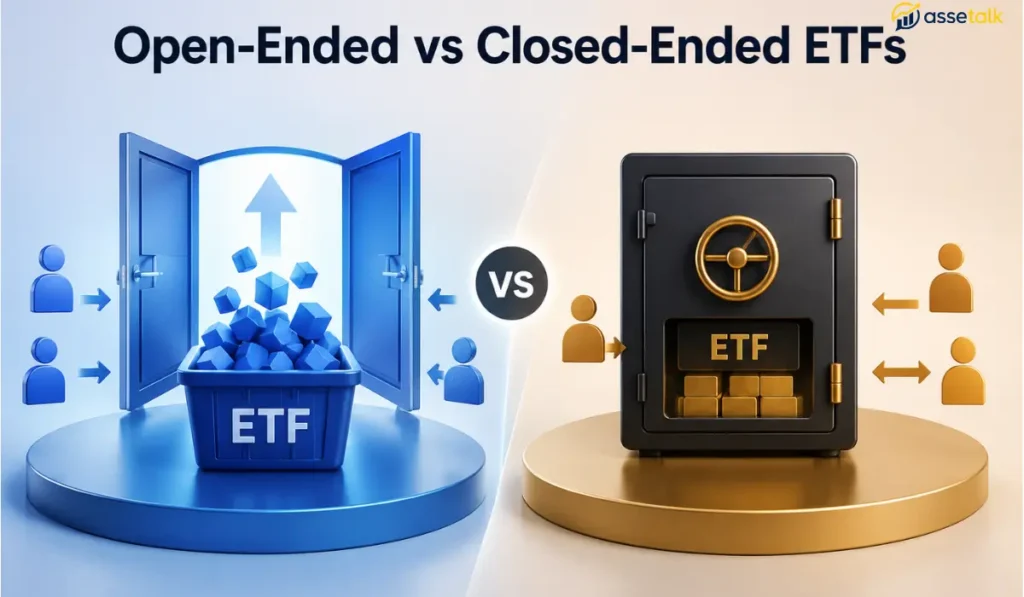
Investing in Exchange-Traded Funds (ETFs) has transformed how everyday investors build wealth. They offer an easy, cost-effective way to buy a diversified basket of assets in a single transaction.
However, when exploring ETF options, you will likely come across two distinct structural models: open-ended ETFs and closed-ended ETFs. Understanding the differences between open-ended vs closed-ended ETFs is crucial for making informed choices about where to put your hard-earned dollars. While both offer exposure to various markets, they handle liquidity, pricing, and share creation in fundamentally different ways. This comprehensive guide breaks down how each ETF structure works, their pros and cons, and how to choose the right coverage for your investment portfolio.
An open-ended ETF is the standard format most investors encounter on the stock market today. Its defining feature is a flexible capital structure that adjusts constantly based on investor demand. Unlike closed-end funds, an open-ended ETF can create or redeem shares as needed, helping its market price remain closely aligned with the value of its underlying assets. This structure allows investors to buy and sell ETF shares throughout the trading day while maintaining efficient access to diversified investment exposure.
Open-ended funds do not have a fixed limit on the number of shares they can issue. Instead, their share supply expands or contracts through a process called creation and redemption. This mechanism is an important part of ETF investing because it helps keep the fund’s market price aligned with its underlying assets.
When demand for an ETF increases, authorised participants typically acquire the underlying securities and exchange them with the fund provider for newly created ETF shares. Conversely, when investors sell heavily, these participants can return ETF shares to the fund in exchange for the underlying assets, causing those shares to be redeemed.
As a result, the supply of ETF shares can adjust to changes in investor demand. This process helps keep an open-ended ETF’s market price close to its Net Asset Value (NAV), which reflects the value of its underlying holdings.
A closed-ended ETF operates on a completely static capital structure. Once launched, the door closes to new capital, changing how the shares behave on the open market.
Unlike open-ended funds, a closed-ended fund raises capital through a single Initial Public Offering (IPO). After this initial raise, the fund issues a fixed number of shares that trade publicly on stock exchanges.
No new shares are created or destroyed in response to everyday buying and selling. Investors simply trade existing shares with one another on the secondary market. Because the supply of shares remains completely fixed, pure market demand dictates the trading price. As a result, closed-ended funds frequently trade at a premium above their Net Asset Value or at a discount below it.
To select the best vehicle for your strategy, it helps to compare these two structures side-by-side across core trading metrics.
| Feature | Open-Ended ETFs | Closed-Ended ETFs |
| Share Supply | Variable (continuously created/redeemed) | Fixed (determined at IPO) |
| Pricing Mechanism | Trades very close to Net Asset Value (NAV) | Trades at a premium or discount to NAV |
| Trading Liquidity | Highly liquid due to active creation/redemption | Dependent on fixed trading volume |
| Leverage Potential | Low to moderate | High (often uses leverage to boost income) |
| Portfolio Management | Primarily passive tracking | Frequently actively managed |
| Expense Ratios | Generally low | Moderate to high |
Open-ended funds dominate the modern investment landscape for several good reasons, though they may not suit every yield-focused strategy.

Closed-ended funds remain a favourite choice among income-seeking investors and niche asset specialists.
Selecting between an open-ended or closed-ended structure depends on your financial goals, risk tolerance, and investment horizon.
Both open-ended and closed-ended ETFs hold a valid place in a modern investor’s toolkit. Open-ended ETFs offer unparalleled liquidity, low costs, and price stability tied directly to NAV, making them the default choice for core index investing. Conversely, closed-ended funds provide income hunters with access to higher yields and strategic discount opportunities, albeit with extra price volatility and higher fees. By evaluating your primary goals-whether that is low-cost capital growth or high dividend cash flow-you can comfortably choose the right fund structure to power your portfolio forward.